ABOUT THE ARTIST
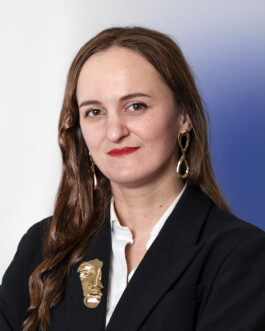
Hermine Patch (b. 1996) is a Slovakian-born fine art photographer based in London, specialising in staged portraiture and still life. Winner of the British Photography Awards 2025 (Fine Art), she constructs cinematic imagery informed by architecture, interior design, and science-fiction aesthetics. Meticulously selected environments shape the narrative and atmosphere of her photographs. Architectural forms, geometric compositions, and controlled colour palettes are employed not simply as aesthetic devices, but as structures through which psychological states can be examined.
Within the framework of a cosmic journey, Patch explores the human condition, drawing on a fascination with consciousness, perception, identity, and the social pressures that shape contemporary experience. She endeavours to transport viewers into realms that feel both unfamiliar and strangely recognisable, where space and time blur into an indefinite continuum. Opting for settings reminiscent of spaceship interiors, she places her subjects within immersive environments that encourage prolonged looking and reflection, offering a counterpoint to an increasingly mediated and overstimulating world. Yet the stillness these scenes propose is not entirely reassuring, often revealing tensions that remain hidden beneath the distractions of everyday life.
This underlying uncertainty reflects Patch's broader interest in the existential inquiries that naturally arise when confronted with the vastness of the cosmos. She imagines outer space not as a destination but a condition of looking. Her works do not seek to provide answers; rather, they leave room for meaning to emerge through observation, introspection, ambiguity, and presence.
ABOUT THE ARTIST
Hermine Patch (b. 1996) is a Slovakian-born fine art photographer based in London, specialising in staged portraiture and still life. Winner of the British Photography Awards 2025 (Fine Art), she constructs cinematic imagery informed by architecture, interior design, and science-fiction aesthetics. Meticulously selected environments shape the narrative and atmosphere of her photographs. Architectural forms, geometric compositions, and controlled colour palettes are employed not simply as aesthetic devices, but as structures through which psychological states can be examined.
Within the framework of a cosmic journey, Patch explores the human condition, drawing on a fascination with consciousness, perception, identity, and the social pressures that shape contemporary experience. She endeavours to transport viewers into realms that feel both unfamiliar and strangely recognisable, where space and time blur into an indefinite continuum. Opting for settings reminiscent of spaceship interiors, she places her subjects within immersive environments that encourage prolonged looking and reflection, offering a counterpoint to an increasingly mediated and overstimulating world. Yet the stillness these scenes propose is not entirely reassuring, often revealing tensions that remain hidden beneath the distractions of everyday life.
This underlying uncertainty reflects Patch's broader interest in the existential inquiries that naturally arise when confronted with the vastness of the cosmos. She imagines outer space not as a destination but a condition of looking. Her works do not seek to provide answers; rather, they leave room for meaning to emerge through observation, introspection, ambiguity, and presence.